 Historical Figure MBTI
4 min read
#193 · 3-20-26 · Ancient Athens
Hermias of Atarneus
The Tyrant-Philosopher of the East
† 341 BCE
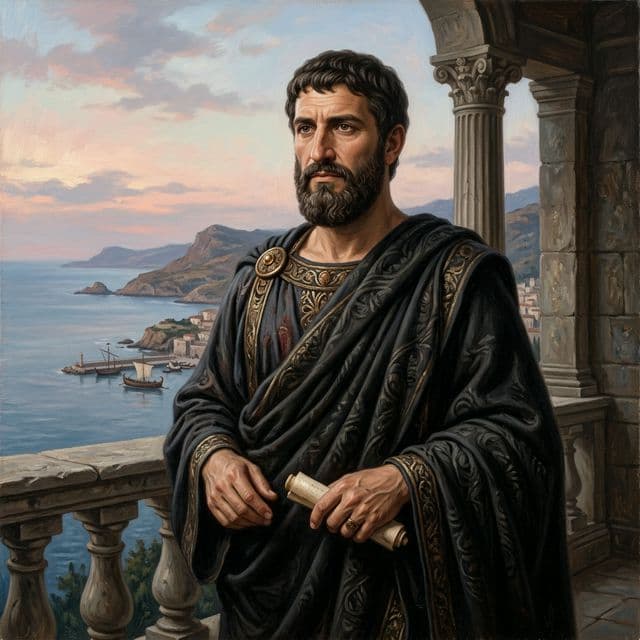
AI-assisted portrait of Hermias of Atarneus
The Architecture of Sovereignty
Hermias did not wait for a throne; he bought one. As a former slave who rose to become the ruler of Atarneus and Assos, his life was a testament to the absolute power of strategic will and the pursuit of institutional excellence. He was a man who saw the world as a system that could be mastered through force, finance, and philosophy.
His journey was defined by his patronage of Aristotle and the Academy, seeking to ground his political power in the most sophisticated intellectual frameworks of his time. His personality was a singular engine of command, driving toward a structured, prosperous, and philosophically grounded state, even as he navigated the precarious politics of the Persian frontier.
Historical Context
Hermias was a ruler of the city of Atarneus in Asia Minor. After studying with Plato and Aristotle in Athens, he returned to his kingdom and turned it into a center of philosophical inquiry, hosting Aristotle for several years. His proximity to the Persian Empire eventually drew him into international intrigue; he was captured by the Persians, tortured to reveal Macedonian plans, and died a "philosopher's death," reportedly saying his last regret was not having lived long enough to finish his work.
The Psychological Verdict
Hermias reads most clearly as ENTJ. He was a leader driven by the organization of external structures and the pursuit of large-scale objective results (Te), guided by an intuitive sense of the shifting strategic landscape of the East (Ni).
Te — Dominant
Hermias’s primary mode was the command of reality. From his rise as a financier to his rule as a tyrant, he focused on efficiency, infrastructure, and the expansion of his kingdom's influence. He saw philosophy as a structural tool—a way to refine the governance and the long-term stability of his realm through organized knowledge.
Ni — Auxiliary
Beneath his administration lay a far-reaching strategic vision. He understood the precarious position of his kingdom between Greece and Persia and sought to position himself as a pivotal node in the future of the Hellenic world. Auxiliary Ni gave him the foresight to gamble on Aristotle and the Macedonian alliance, seeing the potential for a unified Greek culture long before its ultimate fruition.
Se — Tertiary
His rule was characterized by a strong presence and an appreciation for the tangible results of power—monuments, wealth, and military strength. Tertiary Se provided the energy for his political maneuvers and the physical resilience that allowed him to endure torture without betraying his allies, maintaining his focus on his impact until the very end.
Fi — Inferior
Hermias’s personal internal life was highly private, often hidden beneath his public role. His inferior Fi manifested in his absolute, unshakeable loyalty to his philosophical friends, becoming the emotional anchor that defined his final sacrifice. He died for his values, proving that beneath the tyrant's command lay a deep, if rarely shown, commitment to personal integrity.
The Patron Who Paid the Full Price
Hermias started life as a slave, rose to become a banker’s assistant, studied under Plato at the Academy, and eventually took control of the city of Atarneus through a combination of political acuity and the power vacuum left by his former employer’s death. He invited Aristotle to his court, gave him his niece Pythias in marriage, and provided the conditions for nearly three years of uninterrupted philosophical work that preceded Aristotle’s summons to Macedon. When the Persian satrap Mentor of Rhodes captured him through treachery, he was tortured and crucified on orders from Artaxerxes III — tortured for information on his connections to Philip II that he reportedly refused to provide. His last words, according to Aristotle, were that he had done nothing unworthy of philosophy. Aristotle wrote him a hymn — the Hymn to Virtue — one of the only surviving personal poems from the philosopher’s corpus. That a man of Hermias’s origins died like this, and was mourned like that, tells you everything about what philosophy meant to those who actually believed in it.
Not the one who asked what was right. But the one who made the right thing real through power.
Connected Figures
Further Reading
- Aristotle: A Very Short Introduction — Jonathan BarnesA concise entry into Aristotle's life and thought, including the Atarneus years and Hermias's role as patron.
- Aristotle: The Desire to Understand — Jonathan LearTraces how Aristotle's philosophical development was shaped by his time at Assos — the court Hermias made possible.
- The Greeks Overseas — John BoardmanContextualizes the Greek settlements on the Anatolian coast where Hermias built his small but remarkable philosophical statelet.
