 Historical Figure MBTI
5 min read
#180 · 3-19-26 · Ancient Athens
Archimedes
The Mind That Measured the World
† 212 BCE

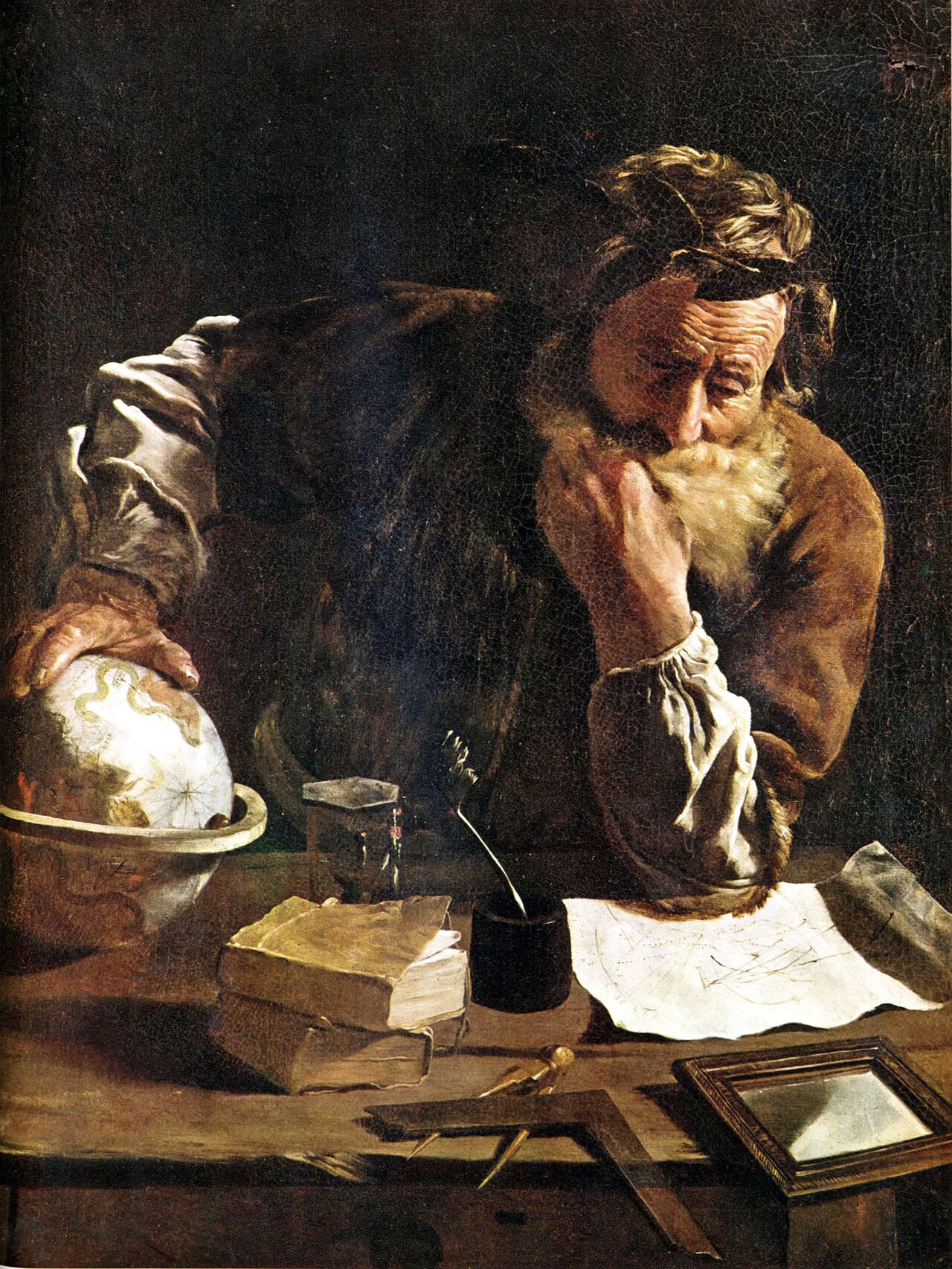
AI-assisted portrait of Archimedes
The Precision of Truth
Archimedes did not set out to conquer the world. He set out to understand it.
Born in Syracuse, he lived at the intersection of theory and application—a mathematician, engineer, and inventor whose work would shape geometry, physics, and mechanics for centuries. He designed war machines that defended his city against the Roman siege, yet regarded these creations as secondary to his true pursuit.
What mattered to Archimedes was not utility. It was truth.
Even the story most associated with him—the sudden realization of displacement while bathing—is not about invention, but about insight. A moment where observation aligned with underlying principle.
He did not chase ideas. He refined them until they held.
The Psychological Verdict
Archimedes is often remembered as an inventor, which can give the impression of outward experimentation and creative exploration. But a closer look reveals a different pattern: a mind oriented not toward generating possibilities, but toward establishing certainty.
He reads most clearly as INTP.
Ti — Dominant
At the core of Archimedes’ work is precision. His mathematical proofs are not approximations or models—they are exact, internally consistent, and rigorously derived. Whether determining the area of a circle, the volume of a sphere, or the principles of leverage, his focus is on what must be true within a logical system.
This is Ti at its core: internal coherence, exactness, and the pursuit of structural truth. He is not satisfied with what works. He seeks what holds.
Ne — Auxiliary
Though precise, his thinking is not narrow. Archimedes moves across domains—geometry, hydrostatics, mechanics—applying similar logical frameworks to different problems. His insights often emerge from reframing a situation, seeing a structure where others see complexity.
The “Eureka” moment reflects this: not random inspiration, but a sudden connection between observation and principle. This is Ne in service of Ti—generating perspectives that allow the system to resolve.
Si — Tertiary
His work builds upon established mathematical traditions, particularly those of earlier Greek geometers. Archimedes does not discard these foundations; he extends them. His methods rely on careful accumulation of known principles, refined and applied with increasing precision.
There is continuity in his thinking—a respect for what has already been established, even as he pushes it further. This reflects tertiary Si: grounding innovation in existing structure.
Fe — Inferior
What is notably absent is any strong concern for social context or external alignment. Archimedes is often described as deeply absorbed in his work, indifferent to status, recognition, or even immediate danger. His death—reportedly occurring while he was engaged in a geometric problem—reflects a mind detached from its surroundings when focused.
This is inferior Fe: minimal attention to interpersonal dynamics, with energy directed inward toward the system itself.
Analysis
Why not ENTP?
At a glance, Archimedes’ creativity and range can resemble ENTP—a figure generating ideas, experimenting, and engaging dynamically with the world. But the orientation is different.
ENTPs lead with exploration. They move quickly between possibilities, testing ideas through interaction and expansion. Archimedes does not explore for its own sake. He resolves.
His work is not a series of possibilities, but a progression toward certainty. His inventions are byproducts of understanding, not expressions of curiosity alone.
This is not Ne-driven ideation. It is Ti-driven refinement.
The Line That Cannot Be Broken
Archimedes’ legacy is not defined by what he built. But by what he proved. His theorems endure not because they were useful, but because they are true—independent of time, context, or application. They do not require defense. They hold.
Even in death, he is said to have asked not to have his diagrams disturbed—a final insistence on the integrity of the system he was working within.
Not the inventor of machines. But the one who ensured the world could be measured at all.
Connected Figures
Further Reading
- The Works of Archimedes — T. L. Heath (ed. & trans.)The standard English translation of the primary texts — On the Sphere and Cylinder, On Spirals, The Sand-Reckoner, and more.
- The Archimedes Codex — Reviel Netz & William NoelThe story of the palimpsest that recovered lost Archimedean proofs, including the Method — a window into how he actually thought.
- Infinite Powers — Steven StrogatzTraces the conceptual lineage from Archimedes' proto-calculus to Newton and Leibniz; vivid on what made his method extraordinary.
- Archimedes: What Did He Do Besides Cry Eureka? — Sherman SteinAn accessible mathematical tour of Archimedes' actual proofs — for readers who want to follow the reasoning, not just the legend.
