 Historical Figure MBTI
5 min read
#211 · 3-21-26 · The Age of Alexander
Ptolemy I Soter
The Savior of Egypt
r. 305 – 282 BCE
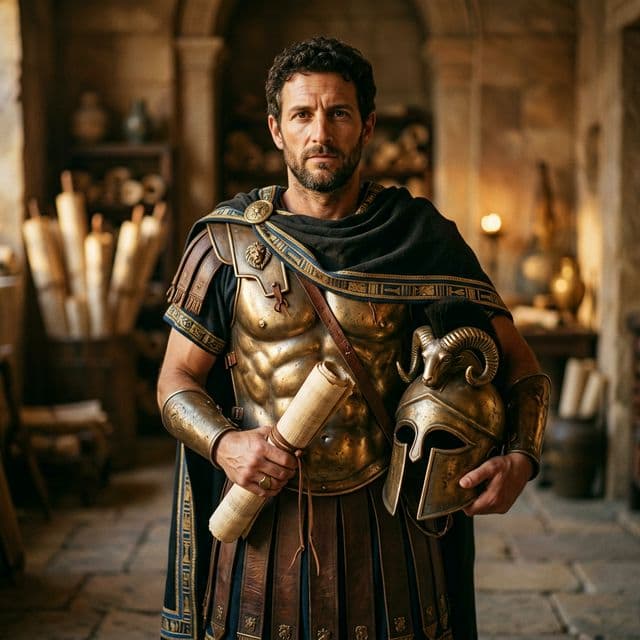
AI-assisted portrait of Ptolemy I Soter
The Architecture of Pragmatism
Ptolemy I Soter did not just win a war; he founded a world. While his lifelong friend Alexander the Great sought a universal, visionary expansion (Fe-Ni), Ptolemy’s genius was profoundly structural and pragmatic (Te). He was the first of the Diadochi to realize that the empire as a whole was unsustainable, and he acted with a cold, analytical efficiency to secure the most stable and wealthy portion—Egypt—for himself. His personality was oriented toward the building of lasting institutions rather than the pursuit of infinite horizons.
He was the architect of the Hellenistic future. From the hijacking of Alexander’s funeral carriage to the founding of the Library of Alexandria, Ptolemy’s cognitive mode was focused on the objective consolidation of power and the creation of intellectual infrastructure. He was a leader who valued stability, logistics, and the efficient management of reality.
Historical Context
Ptolemy I Soter was a Macedonian general and companion of Alexander the Great. After Alexander's death in 323 BCE, he secured the satrapy of Egypt and successfully defended it against his rivals, eventually declaring himself King in 305 BCE. He founded the Ptolemaic dynasty, which would rule Egypt for nearly three centuries, and was the primary patron behind the Library and Museum of Alexandria. His reign transformed Egypt into the intellectual and economic powerhouse of the Mediterranean world.
The Psychological Verdict
Ptolemy I Soter is a classic ENTJ. He was a leader defined by his relentless focus on external organization and effective command (Te), guided by a clear, long-term strategic vision for his kingdom (Ni), and supported by a pragmatic engagement with the physical world (Se).
Te — Dominant
His primary mode was the reorganization of reality into more efficient systems. Ptolemy’s decision to take Egypt was a masterstroke of logistical logic; it was the easiest territory to defend and the richest to exploit. His reign was characterized by the establishment of a centralized, efficient bureaucracy that integrated Greek and Egyptian systems. He didn't just want to rule; he wanted the system to function at peak performance.
Ni — Auxiliary
Supporting his will was a deep, intuitive understanding of the shifting winds of history. Ptolemy foresaw the collapse of the unified empire long before the others and prepared accordingly. This auxiliary Ni allowed him to build a dynasty that outlasted all of his rivals, using cultural and religious synthesis (such as the creation of Serapis) to glue his heterogeneous kingdom together. He was a man who planned in centuries, not just seasons.
Se — Tertiary
Like his fellow Macedonian commanders, Ptolemy was a man of action who thrived in the physical reality of the battlefield. His tertiary Se gave him the tactical flexibility to defeat Perdiccas and the resilience to survive decades of constant warfare. He was a strategist who understood the weight of the sword as clearly as the weight of the scroll.
Fi — Inferior
His narrow focus on external achievement and the building of a state often left his internal world—and his personal attachments—as secondary considerations. While he was reportedly a fair and temperate ruler, his decisions were always driven by the objective needs of his dynasty and his kingdom, reflecting an inferior Fi that prioritized systemic success over subjective sentiment.
The Pragmatist Who Outlasted Them All
Of all the men who stood beside Alexander, Ptolemy was the one who understood most clearly that the empire was already ending while Alexander was still building it. He didn’t fight for the whole — he took Egypt, fortified it, and watched. Antigonus tried to hold everything together and died at Ipsus. Seleucus built an empire stretching to India and was assassinated at 77. Cassander controlled Macedonia but his dynasty collapsed within a generation. Ptolemy died in his bed at 84, having founded the Library of Alexandria, stolen Alexander’s corpse for the legitimacy it conferred, and established a dynasty that would last 275 years. He also wrote a firsthand account of Alexander’s campaigns — now lost, but used by Arrian and considered the most reliable source. The most influential thing Ptolemy ever did may have been to survive long enough to write it down.
Connected Figures
Further Reading
- Ptolemy of Egypt — Walter M. EllisThe only modern English-language biography dedicated to Ptolemy I — covers his military campaigns, dynastic strategy, and the founding of Alexandria.
- The Wars of Alexander's Successors 323–281 BC — Bob Bennett and Mike RobertsA detailed military history of the Diadochi wars in which Ptolemy fought his way to control of Egypt.
- Ptolemaic Egypt — Alan K. BowmanThe authoritative chapter in the Cambridge Ancient History, Vol. 10, covering the Ptolemaic dynasty from its founding.
- The Library of Alexandria: Centre of Learning in the Ancient World — Roy MacLeod (ed.)Essays on the institution Ptolemy founded — its intellectual scope, its scholars, and its long legacy.
